Simplifying the Bolt Plus journey to drive more membership
Bolt · Apr, 2026
Bolt Plus included meaningful perks — ride savings, cashback on orders, free food delivery, and priority matching. It was a strong offer, particularly for our most frequent users who relied on Bolt for their daily routines.
Yet adoption told a different story...
When I pulled the Mixpanel data, about one in five users who landed on the offer page from Bolt's ride hailing app actually subscribed. In the Bolt Food app it was closer to one in six. That felt like a significant gap between what we were offering and what users were hearing.
The page was built for us, not for the user.
The first thing I noticed when I looked at the existing page: it was structured around how Bolt sells its products internally. Rides benefits first. Food benefits next. Clean vertical separation that made perfect sense in a product spec and zero sense to someone standing at a bus stop wondering whether €4.99 a month was worth it.
The purchase flow was hidden behind a "Join Now" button that led to a multi-step process. No price visible before clicking. No sense of what you were committing to. The savings — the most compelling part of the pitch — were nowhere to be found on the first screen.
Once I could see the page through a user's eyes, the diagnosis was quick: we were asking people to make a financial decision before giving them a reason to say yes.
Three things needed to change. None of them were cosmetic.
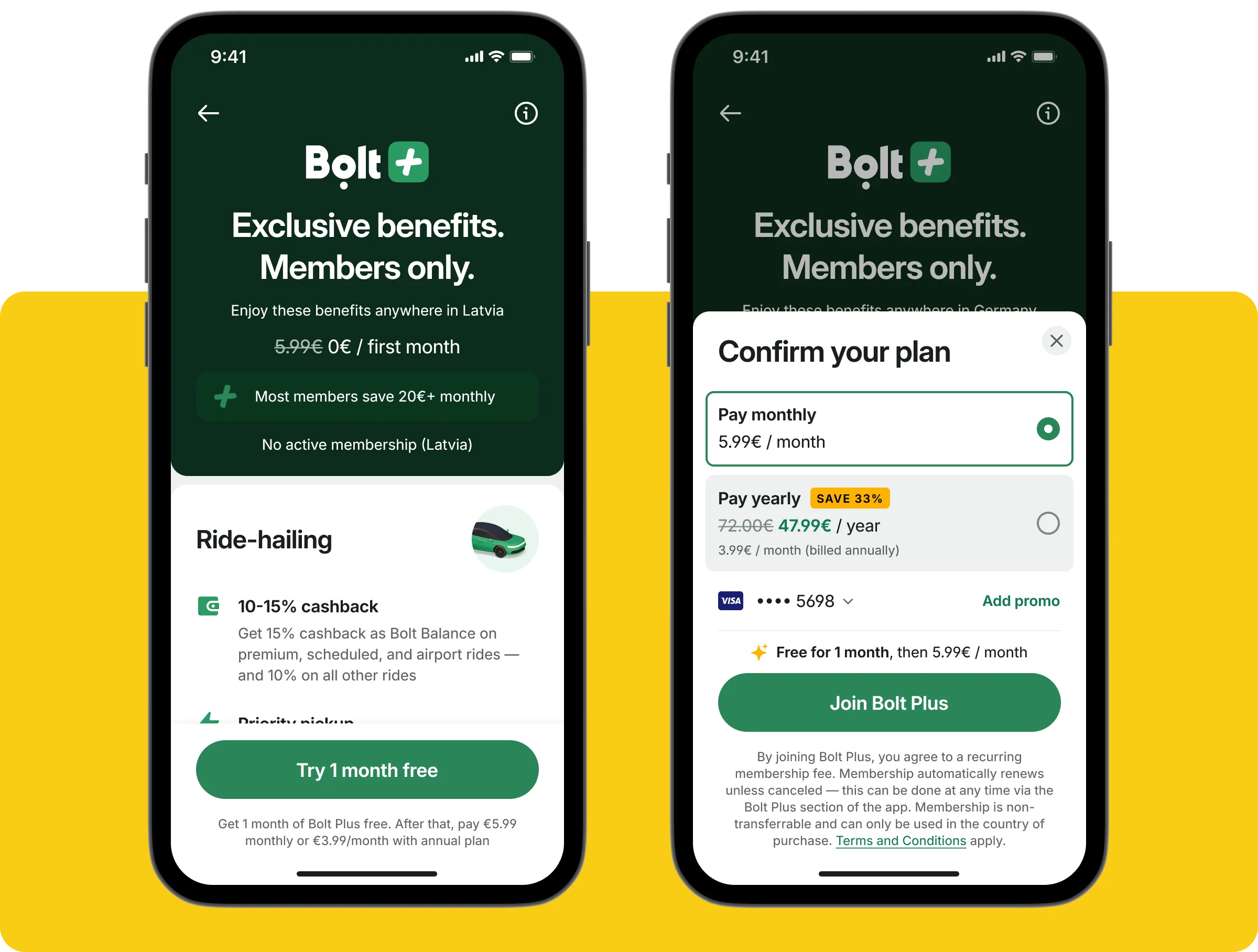
Previous version of Bolt Plus new member page
Move the purchase flow to where users are already looking.
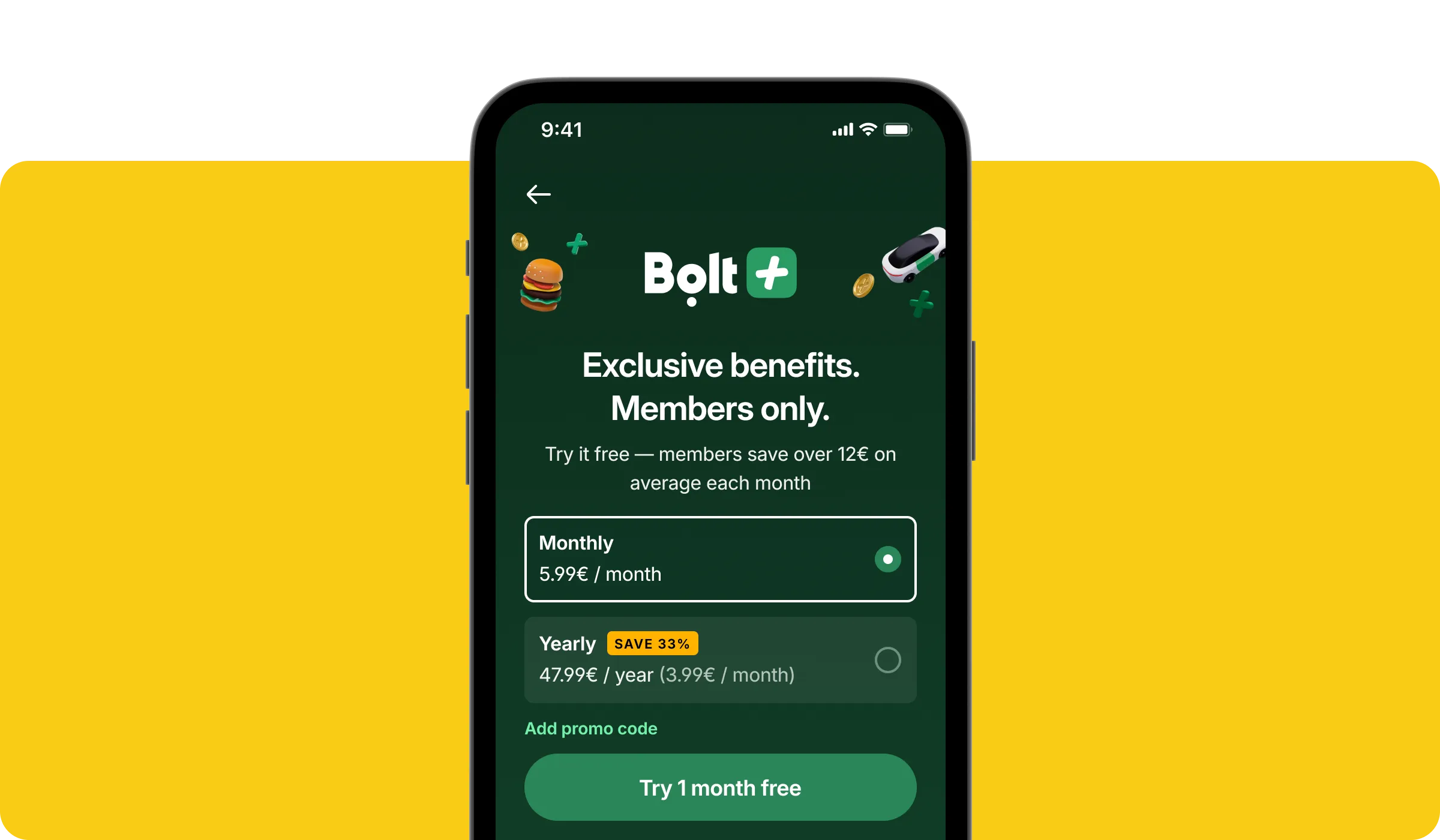
The CTA had no business being buried. I shifted the purchase flow to the top of the screen, ensuring the path from interest to subscription required zero navigation. It sounds like an obvious choice in hindsight — most impactful design decisions usually do.
The page leverages subtle, on-brand animations to reinforce the Bolt identity — moments of delight that feel less like decoration and more like a natural extension of the experience.
Surface the savings immediately — and make the annual plan an obvious choice.
We started showing two options upfront: monthly and annual, side by side, with the monthly price as an anchor. A "Save 33%" badge on the annual plan makes the discount visible without asking the user to do arithmetic. It's a well-established pattern in subscription UX, and it works because it externalises the decision. Users don't have to calculate whether it's worth it — we tell them.
Below the plans, a personalized copy reinforced the value: "You would've saved €14 last month." Retroactive, specific, and impossible to ignore if the number is meaningful to you.
Sort benefits by what matters to the user, not what matters to us.
Reordering the benefits list by impact priority and made it context-aware: if you arrived from the Bolt's Rides app, ride hailing benefits appear first. Delivery users see delivery perks at the top. The page adapts to the context it's opened in — which turned out to be easier to implement than it sounds, since the page runs as a shared webview between both apps and already receives a client parameter at launch.
One small decision that quietly saved a lot of conversions.
The payment step deserves a mention on its own. When a user has no saved card, most flows either show an empty state or push them straight to a card entry form. Both kill momentum at the exact moment intent is highest.
Instead, we pre-select the OS-native wallet — Apple Pay on iOS, Google Pay on Android.
Involuntary churn from failed payments is a major issue across subscription services; for Bolt Plus, our data shows that approximately 40% of churn is caused by payment failures, with insufficient funds or exceeded credit limits accounting a lot of those failures.
The user arrives at the payment screen already set up. If they prefer a card, "Add payment method" sits below as a secondary option. And critically: after adding a card, they return directly to the payment selection sheet with their new card already chosen. It sounds like a minor routing detail. In practice, losing users after card entry is one of the most common silent drop-offs in subscription flows.
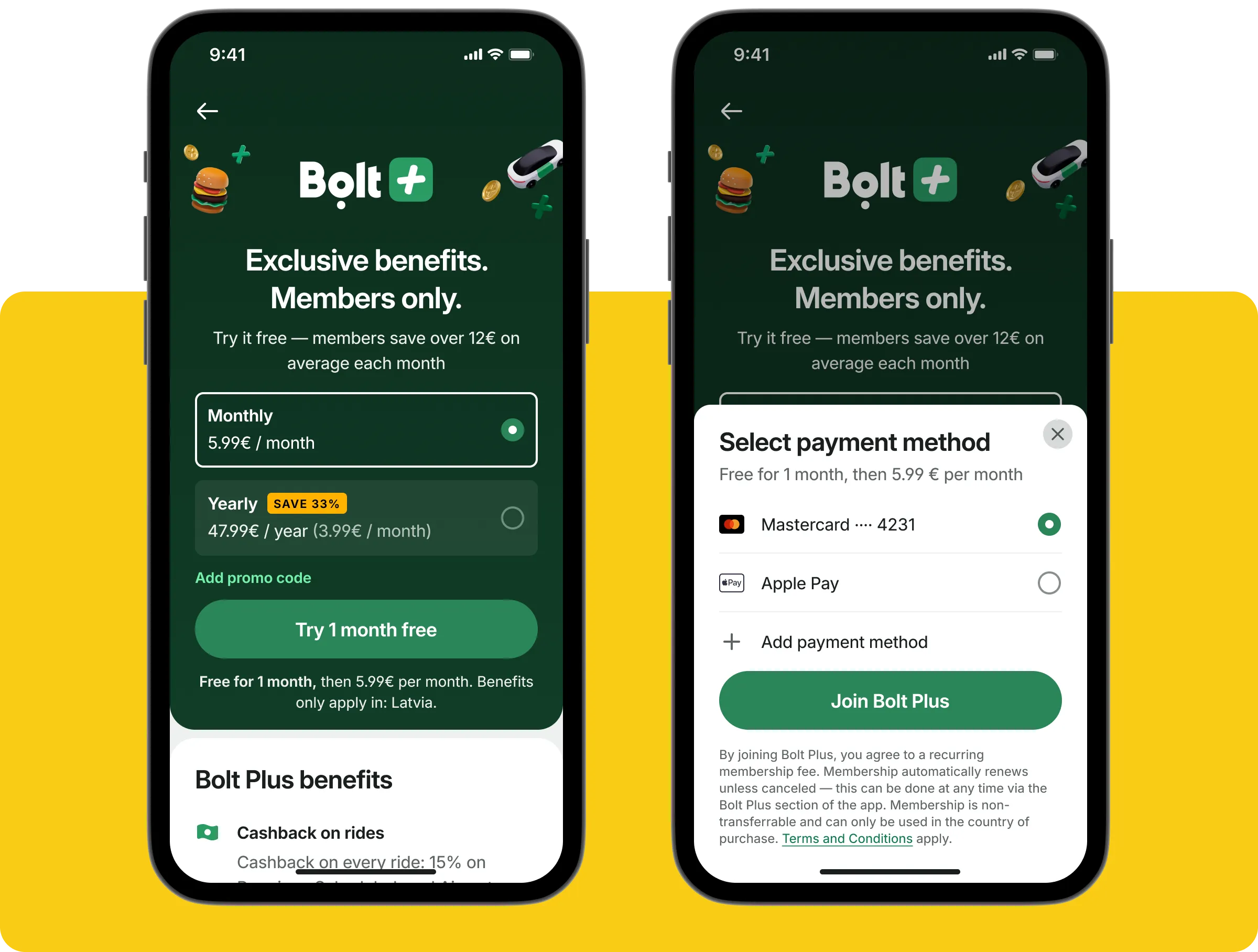
New version of Bolt Plus member signup page after design updates
Testing which changes works
Our team ran the test as A/B/C rather than a simple split. Control kept the existing design. Variant B brought the CTA to the top and surfaced savings, but kept the original benefit ordering. Variant C was the full redesign — CTA placement, savings framing, priority sorting, and context-aware sequencing all together.
The reason for the middle variant: if C wins, you need to know whether it was the CTA move, the hierarchy change, or the combination. Without B, a successful result is uninterpretable and the next project doesn't learn anything specific.
Outcomes
Variant C — the full redesign — won across every metric. Conversion from landing page to completed subscription lifted significantly across both apps. Bolt Food users responded the strongest, moving from roughly 17% to 30% conversion.
The shift toward the annual plan was the most striking single number (19% uplift): meaningful enough to matter to long-term revenue, not just conversion volume.
Closing thoughts
The biggest shift in this project wasn't in the interface — it was in the perspective. The original page made complete sense from the inside of the company. It reflected how the product team thought about Bolt Plus, which categories existed, how the pricing was structured. What it didn't reflect was how a user decides whether something is worth paying for.
Reframing that — moving from "here's what we offer" to "here's why you'd want it" — is the kind of change that looks small on a screen and shows up clearly in a funnel.
The payment routing detail still sticks with me as a reminder that some of the most impactful UX decisions aren't visible in the design file at all. They live in the transitions between screens.